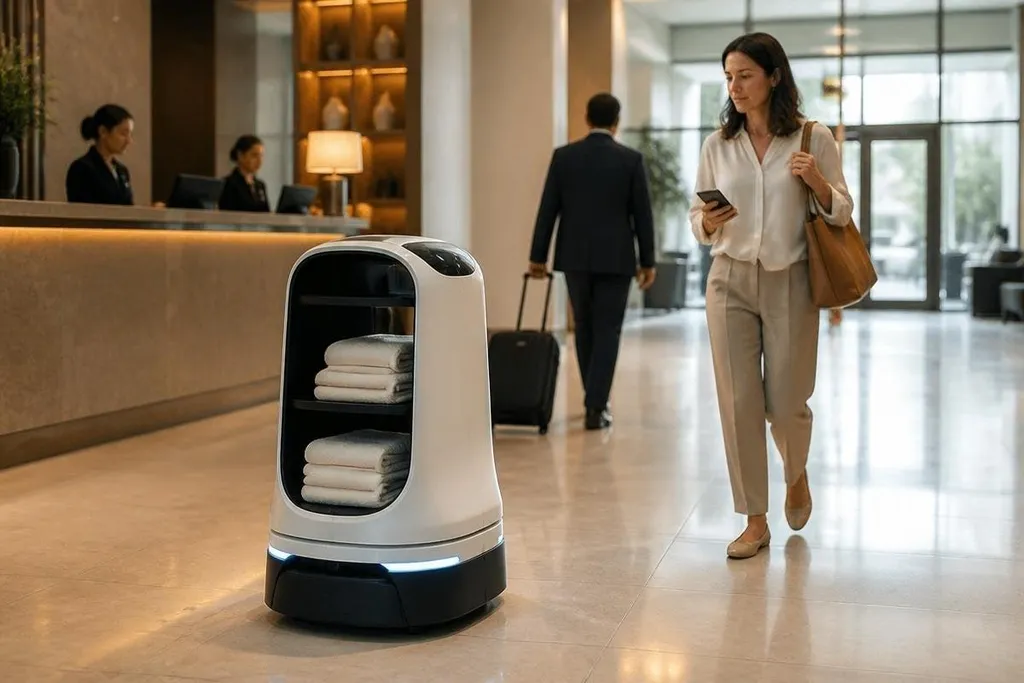
A hotel robot can carry items, move through public areas, or answer a guest request. AI changes how it handles those tasks, but the supplied brief includes no deployment records, prices, dates, or test results to show how well any system works.
- AI can turn spoken requests into robot actions.
- Cameras and sensors help robots map routes around people and furniture.
- Hotel buyers still need proof of uptime, safety, service cost, and guest response.
From fixed routes to changing spaces
Older hotel automation often depends on set routes and fixed instructions. An AI system can use sensor data to choose a route when a hallway is blocked, a lift is busy, or a guest stands in the robot’s path.
That does not make the robot independent in every sense. The hotel still needs mapped floors, safe movement rules, lift access, charging points, and staff who can deal with faults. AI can select an action inside those limits. It can’t repair a lift or clear a blocked corridor.
The useful change is local decision-making. A robot can match a request to a room, select a route, and report a problem when the trip cannot continue. Each part needs a separate test, since a robot that reaches the right floor may still fail at the room door.
Guest requests become robot tasks
Hotel staff deal with many requests in plain speech. A guest may ask for towels, water, or help finding a room. An AI system can turn that sentence into a task with an item, a destination, and a status.
The robot still needs access to the hotel’s order system and a clear handoff process. If staff load the wrong item, the language system can’t fix the mistake. If a guest changes the delivery location, the robot needs a safe way to confirm the new request.
This is where hotel automation needs careful limits. A robot may answer routine questions from approved hotel information, while staff handle complaints, medical needs, payment issues, and requests involving private data.
The brief supplies no evidence about which hotel robots can do this today, so broad claims about guest service remain unproven.
Hotel robots face the building as much as the task. Lifts, locked doors, changing room numbers, and guests can alter a run before the robot reaches its destination. Hotel robotics reporting from Robot24.com can tie those limits to named machines and dated tests before the article looks at the hotel as part of the system.
The hotel becomes part of the system
A robot’s work depends on the building around it. Doors, lifts, floor surfaces, lighting, Wi-Fi, and charging space all affect a delivery. AI may help the robot react to those conditions, but it doesn’t remove them.
Data handling adds another concern. Cameras and microphones can collect information near guest rooms and public areas. The hotel needs rules for what the robot records, how long it keeps that data, and who can access it. Those rules should be set before a trial begins.
Staff training matters too. People need to know how to stop the robot, move it safely, report a fault, and take over a delivery. Buying the robot without clear instructions for these tasks adds another source of delay.
What buyers should ask for
The evidence pack contains no product data, so a buyer should ask vendors for records that can be checked on site:
- Route records: Show completed trips, blocked routes, manual recoveries, and failed deliveries.
- Task limits: List the items, doors, lifts, room types, and guest requests the robot can handle.
- Safety tests: Name the sensors, stop rules, speed limits, and staff steps used around guests.
- Data controls: State what cameras and microphones collect, where the data goes, and when it is deleted.
- Service costs: Give charging, repair, software, training, and support costs as separate figures.
I’d judge a hotel robot by completed tasks and staff workload, not by the AI label on its brochure.
The next useful proof is a dated hotel trial with task counts, failed trips, manual interventions, uptime, and total operating cost. Until those figures are available, AI describes the control system, not the business result.